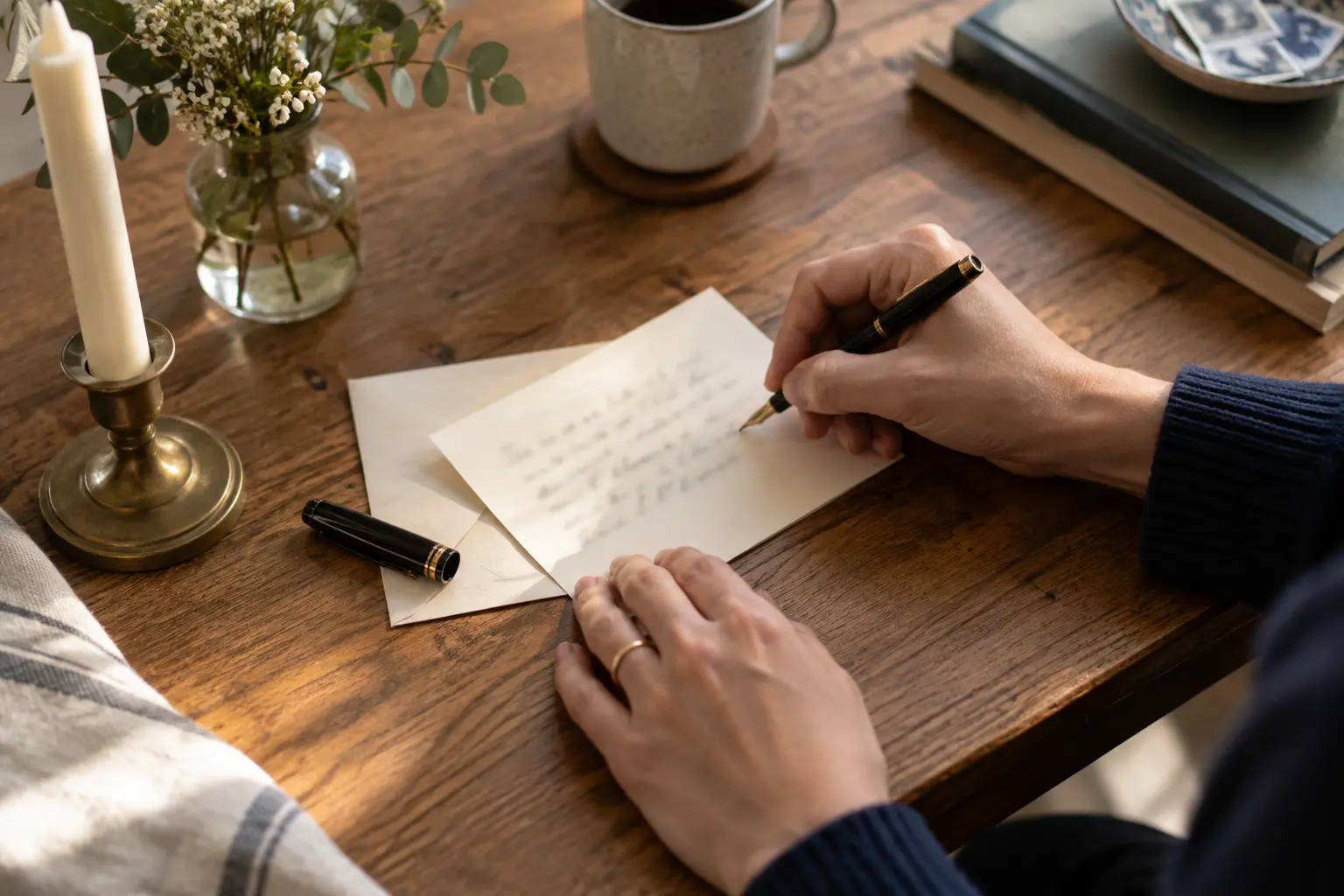
A personal message does not need to be poetic, long, or perfectly polished. It needs to sound as though it could only have been written by you, for one particular person, at one particular moment. That quality comes from attention—not from impressive vocabulary.
Begin with the person, not the occasion
Generic messages usually start with the event: “Happy birthday,” “Congratulations,” or “Sorry for your loss.” Those phrases are useful signposts, but they cannot carry the whole note. Before writing, pause and ask what is distinctive about the recipient. What have they done recently? What do you admire about the way they move through the world? Which shared memory still makes you smile?
Choose one answer and let it shape the message. “Happy birthday to the person who always notices when someone is standing alone” immediately feels more personal than a string of broad compliments. Specificity proves that you have paid attention.
Use a simple four-part structure
Most meaningful notes can be built from four small pieces: name the moment, share one true detail, say what it means to you, and close with a wish. You might write: “I’m so happy you got the new role. I still remember how patiently you rebuilt that first presentation after everyone else had gone home. Your steadiness has always inspired me, and I hope this next chapter gives you room to do your best work.”
This structure works for birthdays, graduations, new babies, sympathy notes, thank-you cards, and ordinary check-ins. The emotional temperature changes, but the underlying logic remains dependable.
Replace labels with evidence
Words such as amazing, kind, beautiful, and strong are pleasant but broad. Rather than calling someone kind, mention the soup they left on your porch or the way they call after every difficult appointment. Rather than saying they are strong, acknowledge a hard choice they made with patience. Evidence makes praise believable.
Write the detail that another person would not know. That is usually where the real message begins.
Match the tone to the relationship
A close friend may appreciate humor, fragments, and an old nickname. A colleague may value warmth with a little more restraint. A grieving person rarely needs optimism or advice; they need companionship and an honest acknowledgment of what hurts. Tone is not a performance. It is the distance at which the recipient feels comfortable.
If you are unsure, read the message aloud. Listen for phrases you would never say in conversation. Replace them with simpler language. Contractions often make a note sound natural. So do short sentences. A single sincere line is better than a paragraph of borrowed sentiment.
Give difficult emotions room
When the moment is painful, resist the urge to repair it. Avoid promising that everything happens for a reason or that things will soon feel normal. Say what you know: “I’m so sorry,” “I miss her too,” or “I’m here to sit with you, bring dinner, or handle errands this week.” Concrete offers reduce the work placed on someone who is already tired.
For an apology, name your action without defending it. A useful apology includes what happened, recognition of its effect, responsibility, and a clear change. “I interrupted you repeatedly at dinner. That was disrespectful and made it hard for you to be heard. I’m sorry. Next time I will slow down and listen before responding.”
Make celebration more vivid
Celebratory notes feel richer when they recognize effort as well as outcome. A promotion represents late nights, practice, patience, and decisions no one saw. A wedding celebrates a relationship, not just a beautiful day. A birthday can honor growth rather than merely count years.
Try finishing one of these stems: “I have loved watching you…,” “You worked so hard to…,” “The part of this I admire most is…,” or “I hope the next year gives you….” Prompts are scaffolding, not finished lines. Add a detail so the final sentence belongs to the recipient.
Edit for warmth, not perfection
On the second read, remove repeated ideas and ceremonial filler. Check names and dates. If the message could be sent unchanged to ten different people, add one memory or observation. If it feels crowded, keep the sentence with the most truth and cut the rest.
Presentation matters, but only in service of the words. A handwritten card creates a physical keepsake. A text reaches someone at the moment they need it. A voice note carries tone. Choose the format the recipient is most likely to welcome, not the one that looks most impressive.
A final five-minute method
- Write the recipient’s name and one quality you value.
- List one recent moment or shared memory that shows that quality.
- Explain in one sentence why it matters to you.
- Add a wish, offer, or expression of support.
- Read it aloud and remove anything that sounds borrowed.
Do not wait for a grand occasion. A message sent on an ordinary Tuesday can be more memorable because it is unexpected. The goal is not to create a flawless miniature speech. It is to make another person feel accurately seen.
Examples for common moments
For a birthday: “I keep thinking about the Saturday you helped me move in the rain and still made everyone laugh. You bring lightness without making hard things feel small. I hope this year returns some of that generosity to you.” The detail carries the praise.
For sympathy: “I am so sorry about David. I will remember the way he made room for every new person at the table. I am bringing soup on Wednesday and can leave it quietly at the door. No reply needed.” This acknowledges the loss, preserves a memory, and offers specific help.
For thanks: “Thank you for reviewing my portfolio before the interview. Your careful questions helped me explain the work with more confidence. I know that took time, and I am grateful.” Naming the effect makes appreciation tangible.
What to avoid
Avoid making the recipient manage your emotions. In a sympathy note, “I do not know what I would do if this happened to me” shifts attention away from them. During celebration, comparisons can diminish the moment. In an apology, explanations placed immediately after “but” often erase responsibility.
Also avoid borrowed intimacy. A highly emotional phrase may feel false in a new relationship. Respectful restraint can be more sincere. Write at the depth the relationship has earned, while leaving room for it to grow.
Keep a small memory practice
Personal writing becomes easier when you collect details before an occasion. Keep a private note with kind things people do, stories they tell, and milestones they mention. This is not a database of obligations; it is an attention practice. Review it before birthdays or thank-you notes.
Protect privacy. Do not record sensitive details you do not need, and never use a personal memory to display closeness publicly without consent. The best detail is one the recipient is comfortable receiving.